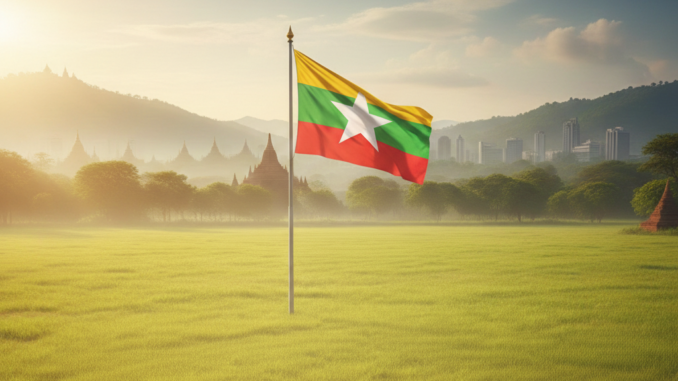
The formation of a new government represents a pivotal moment for Myanmar’s governance. This transition, while framed by the current authorities as a move toward a multi-party democratic system, occurs amid deep skepticism and ongoing instability. The effectiveness of this new administration will be judged by its capacity to restore basic administrative functions and provide a semblance of order in a nation where large swaths of territory remain contested.
A change in leadership does not automatically resolve the structural fragmentation of the economy. For example, high-level strategies such as “technology deployment” often fail in environments where the physical electrical grid is unreliable and there is no legal framework for digital commerce. In addition, the creation of the Union Consultative Council suggests a dual-power arrangement that could further complicate the hierarchy of decision-making.
Myanmar stands at a precarious juncture where internal instability meets a fracturing global order. As the nation navigates a path toward recovery, it faces a convergence of international shifts and domestic hurdles that threaten to stall development for a generation.
The Landscape of Challenges
The current environment is defined by several interlocking pressures:
- Geopolitical Fractures: Global tensions, particularly the competition between major powers, have complicated Myanmar’s trade routes. Sanctions and shifting alliances create a volatile atmosphere for long-term investment.
- The Middle-Income Strain: As neighboring middle-income countries experience economic slowdowns, spillover effects hit Myanmar through reduced foreign direct investment. This creates a secondary layer of economic stagnation.
- Post-Hyper-Globalization: The era of seamless global trade is receding. Myanmar can no longer rely on the old export-led growth model based on cheap labor, as supply chains are regionalizing or returning to developed nations.
- The Green Transition Gap: While the world shifts toward renewable energy, Myanmar lacks the infrastructure to make the transition. This creates a risk of “energy poverty” where the country remains dependent on expensive or unreliable traditional fuel sources.
- Workforce Stagnation: Opportunities for the youth are disappearing. The brain drain of skilled professionals fleeing instability has left a vacuum in the domestic labor market.
Strategic Imperatives for Recovery
To counter these pressures, a multi-faceted approach is required that moves beyond traditional aid models.
- Peace and Stability: No economic framework can function without a baseline of safety. The restoration of stability is the absolute prerequisite for any of the following strategies to take root. Without it, capital flight will continue unabated.
- Blended Workforce Development: Education must evolve to meet the specific needs of a fragmented economy. This involves combining traditional vocational schooling with digital literacy. By focusing on “blended” skills, the workforce can participate in the global digital economy even if local physical infrastructure remains limited.
- Support for MSMEs: MSMEs represent the survival mechanism of the Myanmar people. Strategic support must move beyond simple grants to include technical assistance for supply chain diversification to insulate small producers from border closures and to implement “cluster-based” development, where small businesses in the same sector share resources to lower overhead costs.
- Technology Deployment: Technology should not be viewed as a luxury but as a vital infrastructure replacement. Implementation must focus on expanding internet access to ensure business continuity in conflict-affected zones and deploying mobile-first agricultural tech to provide real-time market pricing to rural farmers who are otherwise exploited by middlemen.
- Community Reinvestment: Wealth generated within specific regions must be cycled back into local infrastructure. This localized approach ensures that even if the central economy struggles, specific communities can maintain a degree of self-sufficiency through improved local clinics, schools, or irrigation projects.
Toward 2030 and Beyond
Myanmar’s path forward is not a simple matter of adopting global trends. It requires a grueling reconciliation of domestic peace with a rapidly changing international economic order. Beyond 2026, the focus must shift from mere stabilization to the structural transformation of the state.
By 2030, Myanmar’s evolution will likely be defined by its ability to transition from a resource-dependent economy to one fueled by human capital and sustainable infrastructure. Myanmar’s long-term prosperity hinges on its role as a strategic bridge between South and South-East Asia. Ultimately, the journey toward 2030 and beyond is about moving from “survival” to “sovereign maturity,” where domestic harmony is no longer a goal to be reached, but the foundation upon which a modern, innovative nation stands.
Facebook: https://www.facebook.com/share/p/1ArATMHpoh/
X/Twitter: https://x.com/naylinoo/status/2037999431916945690?s=20